Our recent Web Hosting Trends Report, which surveyed 446 hosting providers globally, found that 36% of providers identify AI and automation as the single biggest innovation gap in modern control panels.
53% of everyone surveyed expect AI-driven automation to have the biggest impact on the hosting industry in the period ahead. And yet, 27% of providers have not implemented any AI solutions at all.
This post breaks down what the data says about where AI delivers the most operational value, what providers are already doing with it, what cPanel is building, and where to start if your team has not yet made a move.
AI Is the #1 Panel Innovation Gap
According to the report, when hosting providers were asked where control panels should innovate most, 36% chose integrated AI and automation tools. That ranked ahead of advanced security and compliance (19%), better WordPress and CMS integrations (17%), centralized server and license management (15%), and developer tools and API access (6%). AI and automation outranked every other category combined.
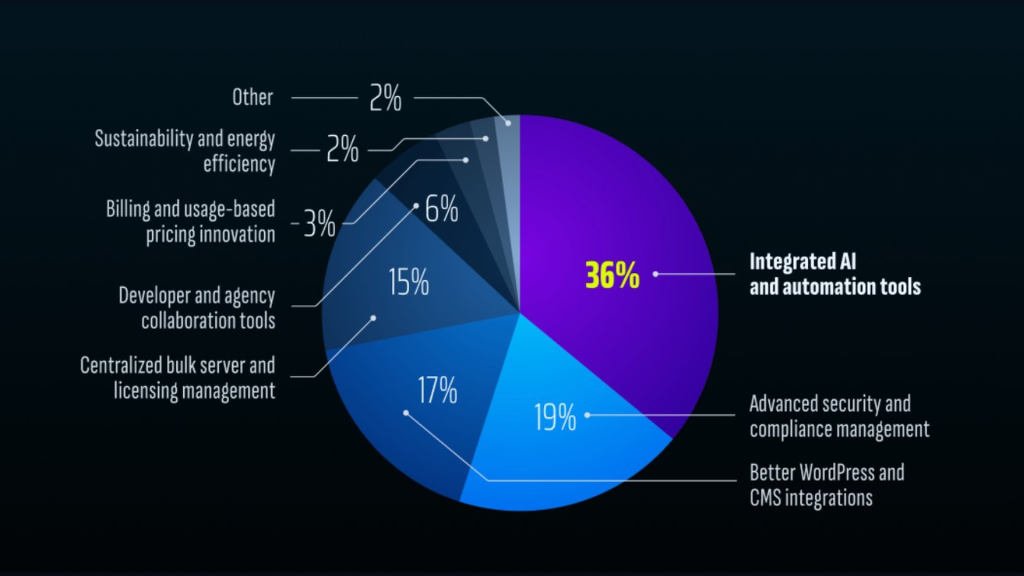
In the next 2-3 years, where do you see the BIGGEST innovation opportunities, for control panels and web infrastructure software?
For a mid-sized provider, this data point matters because it reflects what the market expects from the platforms you operate on. The providers evaluating and purchasing control panels are increasingly making those decisions based on whether AI is embedded in the platform itself.
Where Providers Are With AI Today
The report shows that AI adoption in hosting operations is real but still early: 36% already use AI in customer support, primarily through chatbots and reply suggestions. 30% use AI for server monitoring and optimization, including anomaly detection and smart alerting. 29% deploy AI for cybersecurity threat detection. 27% have not implemented any AI solutions yet.
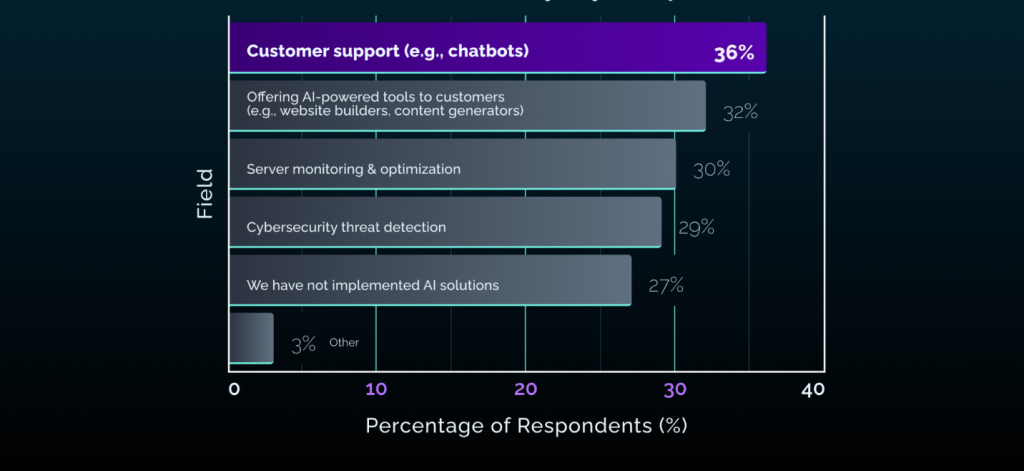
In which areas have you already implemented AI solutions successfully in your operations?
The providers who have started concentrated their initial efforts in support, security, and monitoring, the three areas where operational pressure is highest and the return on automation is most immediate. More than a quarter of the industry has not started at all, which means the competitive window for early adopters is still open.
The Operational Pressure Driving AI Demand
The AI demand data maps directly to where hosting teams are spending the most time and absorbing the most cost.
The report identifies the four largest consumers of support time across the industry: email problems including spam, blacklisting, and deliverability (42%), CMS and application issues such as plugin conflicts and installation help (39%), performance issues including slow sites (35%), and security incidents including hacked sites and malware (35%).
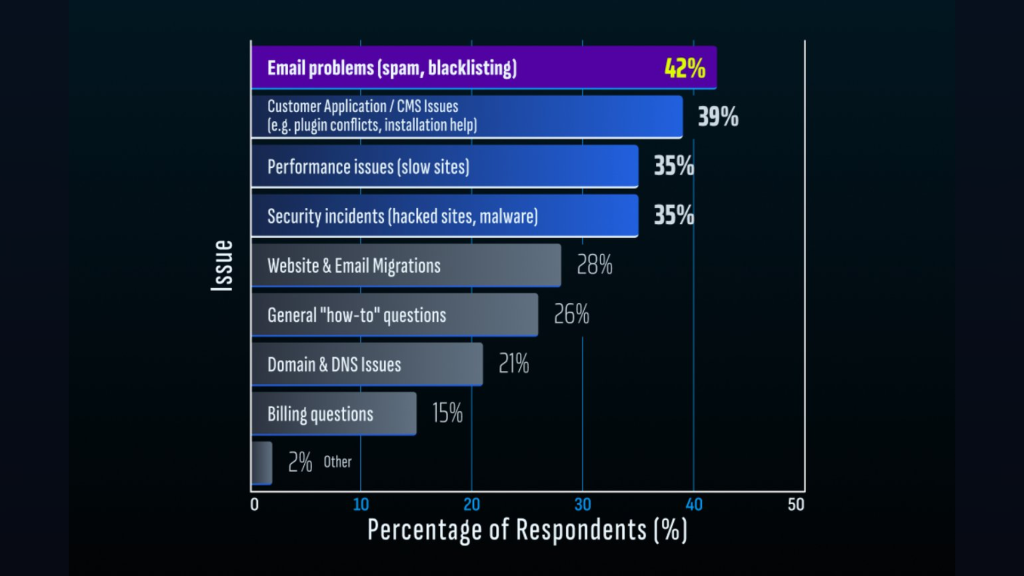
Which of the following topics consume the most support time on a regular basis?
On the security side specifically, 53% of providers cite outdated software and plugins as their biggest security challenge. 51% deal with malware and ransomware. 40% face DDoS attacks. 36% report bot traffic consuming server resources.
These are not edge cases. They are the daily operational reality for the majority of hosting providers, and every one of them is a candidate for AI-assisted automation built directly into the control panel.
What Providers Want AI to Do Inside Their Panel
When asked which AI capabilities would create the most value for their business, providers gave operationally grounded answers: automated security and malware detection (65%), predictive server performance monitoring (48%), AI-driven customer support tools (37%), AI-assisted onboarding and migrations (23%), and billing anomaly detection (19%).
The top two requests are both about catching problems before they reach the customer. Providers are not asking for AI to do new things. They are asking for AI to handle the problems they already manage manually, but earlier, faster, and more consistently.
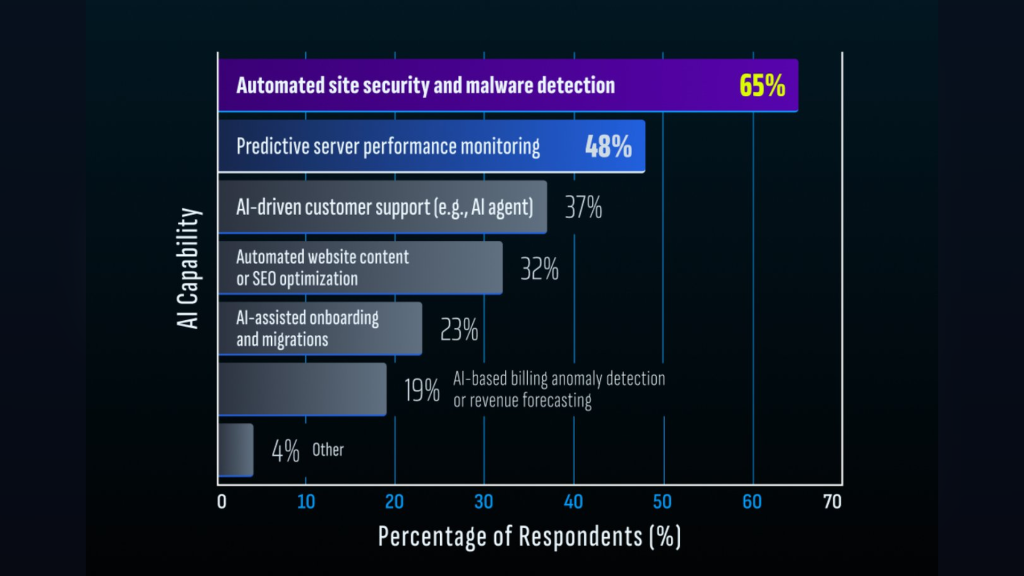
Which of the following AI-enabled capabilities would create the most value for your business?
65% want automated malware detection because 53% are dealing with outdated plugin vulnerabilities and 51% with malware. 48% want predictive performance monitoring because 35% of support time goes to slow site issues. 37% want AI-driven support tools because routine queries consume team capacity that could go toward complex issues.
The connection between where support time goes and where providers want AI deployed inside the panel is the clearest signal in the data about where to start.
What cPanel Is Building
The specific AI capabilities currently in development at cPanel are designed to address the support and troubleshooting patterns the survey identifies. The details are covered in this overview of AI features coming to cPanel, but the two core capabilities worth understanding are:
An embedded AI support assistant that lives inside the cPanel interface. Users can ask questions in plain language and receive contextual guidance, step-by-step workflow direction, and relevant documentation without opening a support ticket. For providers, this means fewer repetitive tickets reaching the support queue and a more consistent experience for end users.
MCP-based troubleshooting integration that enables AI systems to interact with cPanel through a structured protocol. In practice, that means instead of manually checking Apache error logs, PHP configuration, DNS resolution, and file permissions when a site returns a 500 error, an AI-assisted workflow can check those in sequence and surface the likely cause.
Diagnostic workflows become standardized across environments, common issues get identified with less manual effort, and the time per investigation drops. For a mid-sized provider where different team members diagnose the same issue differently, that consistency has direct operational value.
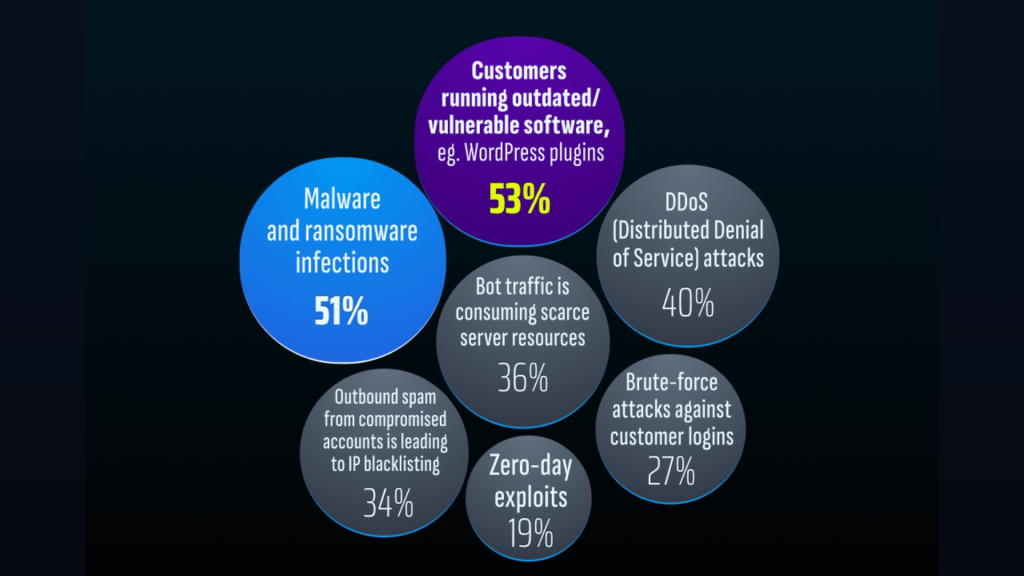
Which of the following security challenges create the most operational overhead or risk for your business?
Both capabilities work within existing permission models and administrative controls, which matters for providers managing multi-tenant environments. The effectiveness of these AI capabilities will also grow as the platform deepens its awareness of the application layer, particularly CMS environments, given that 39% of support tickets originate there.
The more context AI has about what is running inside a server, the more accurately it can diagnose issues and reduce the support burden that sits in the application layer today.
What This Means if You Run cPanel
The survey data and the AI capabilities in development connect to specific operational realities that cPanel users deal with daily. Here is how.
The four largest support drains in the industry, email (42%), CMS issues (39%), performance (35%), and security (35%), are the same categories that generate the highest ticket volume for cPanel-based hosting operations. The embedded AI support assistant is designed to intercept the routine queries within those categories before they become tickets.
When an end user asks “how do I create an email account,” “why is my website not loading,” or “where do I manage my DNS settings,” the assistant provides contextual, step-by-step guidance inside the interface rather than routing that question to your support team. For a provider handling hundreds of accounts, even a partial reduction in routine ticket volume translates directly into recovered team capacity.
The MCP troubleshooting integration changes how your support team investigates issues. Today, diagnosing a 500 error typically means a support engineer manually reviewing Apache error logs, checking PHP configuration, verifying DNS resolution, inspecting file permissions, and piecing together a root cause across multiple tools and log files. Different team members approach that investigation differently, which creates inconsistency in resolution time and quality.
MCP standardizes that sequence. An AI-assisted workflow checks each diagnostic step in order and surfaces the probable cause, giving your team a consistent starting point for every investigation regardless of who picks up the ticket. For a team of five to fifteen people managing a growing fleet, that consistency compounds into a meaningful operational improvement over time.
48% of providers want predictive performance monitoring, and the diagnostic infrastructure being built through MCP creates a natural foundation for that capability. The same structured access to server-level data that enables faster troubleshooting also generates the historical patterns needed to identify degradation before it produces incidents.
For a mid-sized provider, the operational value is direct: a performance issue on a shared server affects multiple customers simultaneously, generating a cluster of tickets that a lean team has to resolve under pressure. Catching the early signals of resource exhaustion, abnormal I/O patterns, or application-level slowdowns before they reach the customer is the difference between proactive service delivery and reactive firefighting.
Both capabilities are in active development, and providers can influence what gets built through the cPanel feature request portal. In the meantime, there are things worth doing now that position your team to adopt these tools with minimal friction when they become available. Documenting the ten most common support scenarios your team handles, including the exact diagnostic steps and resolution paths, creates an internal knowledge base that reduces variation today and becomes the foundation for AI-assisted workflows when they arrive.
Standardizing how your team approaches recurring issue categories, particularly around email configuration, WordPress troubleshooting, and performance investigation, means the transition to AI-assisted diagnostics is a refinement of existing processes rather than a new way of working.
84% of providers rank automation among their top factors when evaluating server software, with 55% selecting the highest possible rating. AI builds on that automation foundation by handling the variable, unpredictable workflows that automation alone cannot address: identifying which server is trending toward resource exhaustion, identifying which customer site is running components with known vulnerabilities, identifying which support ticket can be resolved through guided self-service rather than human investigation. The support drain data tells you where to look first. The AI capability demand data tells you what comes next.
From Operational Efficiency to Competitive Advantage
53% of providers expect AI-driven automation to have the biggest impact on hosting in the period ahead. The providers who will compete most effectively are those who build AI into their operations one use case at a time, starting where the data shows the most pain, and measuring the return clearly enough to justify the next step.
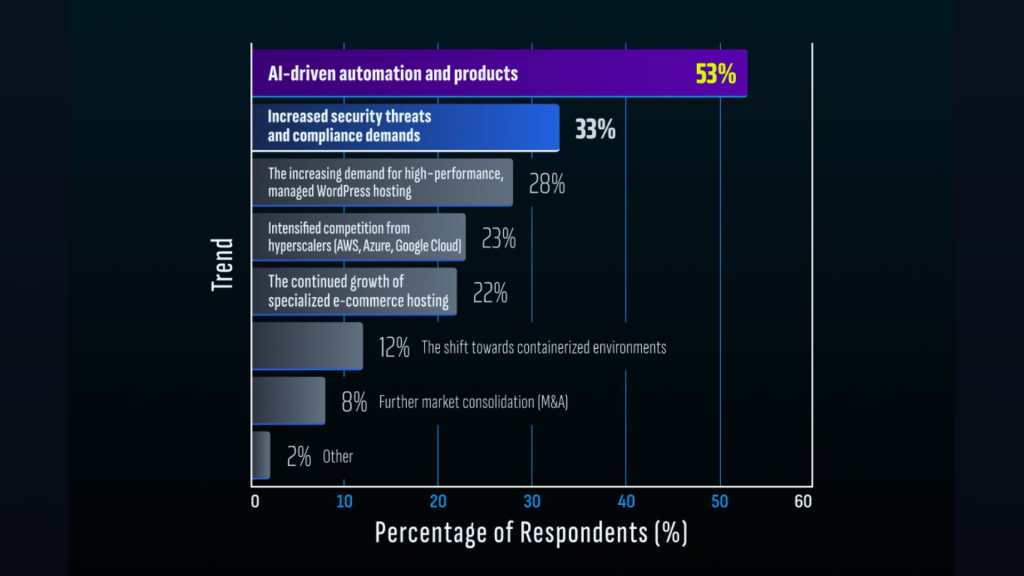
Which of these trends do you anticipate having the biggest impact on the hosting industry in 2026?
At cPanel, that is the framing shaping how the platform continues to evolve: helping providers manage infrastructure more intelligently, at the scale and complexity modern hosting demands.